Chapter 27 is about making your student teaching placement count, in your lessons and in the life of the school around them. It is for student teachers who would like a job offer from the school they are in, or a strong word from its principal. It follows Chapter 26 on learning names, and it pairs well with Chapter 8 on standing out as a teacher candidate and the job search guide.
This is Chapter 27 of 51 from Road to Teaching (2025 edition). Read the whole book free, in order, at Read the Book.
By Dr. Eric Hougan
“There’s a roughness and a surprising nature to most B movies that you don’t get in classic films—something more immediate. I never chose those movies to leave impressions in my brain, they just did.”Tim Burton
Student teaching can lend itself as a golden opportunity in getting one step closer to landing your dream teaching job. Taking the “right step” and not a “misstep” boils down to making a unique and positive impression through your teaching and presence in the school community. If you are interested in working at the school where you are student teaching, keep in mind that principals often prefer to hire people they know and whose teaching abilities they trust. Therefore, going that extra step to ensure that the principal hears only positive feedback about you is critical. This is your time to stand out.
So, how does one stand out? Consider Tim Burton’s quote about B movies at the beginning of this section. B movies, by definition, are not highly polished, but it is that unfinished quality and the surprises they often contain that leave an impression.
You do not have to be the teacher candidate with the perfect grade point average to get stellar results and make a great impression. Instead, you have to put all your effort into producing and teaching an engaging, rigorous curriculum in an equitable, respectful classroom environment.
Push yourself to be an innovator, a researcher of new ideas and best practices, and a calculated risk-taker. Consider the following questions to guide you as you design your lessons:
- How are you leveraging your knowledge of students’ backgrounds, strengths, and interests to inform your lesson planning?
- Do the lessons have clear and understandable learning objectives?
- Are the learning objectives meaningful and connected to the students’ lives?
- Are there a variety of methodologies to reach most of the diverse learners in the classroom?
- In what ways is the lesson going to be fun and engaging (sparks JOY)?
- Are you using alternative assessments (e.g., portfolios, performance assessments, conferences, etc.) to evaluate the students’ learning?
- What is an idea that I can implement to make this an impressionable learning experience for the student?
- What are ways to extend this learning beyond the classroom to impact the broader community (e.g., service-learning project)?
- If I was a student, would this be a lesson I would like to experience?
Current pedagogical approaches offer numerous ways to create memorable learning experiences:
- Technology integration: Use digital tools to enhance learning, but ensure they serve a clear pedagogical purpose
- Authentic assessments: Design assessments that mirror real-world applications of knowledge
- Student choice and voice: Provide options in how students demonstrate their learning
- Cross-curricular connections: Link your subject area to other disciplines for deeper understanding
- Current events integration: Connect classroom learning to contemporary issues students care about
- Collaborative learning: Structure meaningful group work that builds both academic and social skills
- Differentiated instruction: Provide multiple pathways for students to access and demonstrate learning
Moving forward, know that planning, writing, and executing a thoughtful and innovative lesson is only one part of making a good impression during student teaching. As previously mentioned, principals are also looking for teachers who fit well with the culture of their school, its students and staff. Student teaching is not just classroom teaching; it can serve as a testament to who you are as an educator, colleague, and advocate. Administrators will be watching your involvement in the school and community just as much as your teaching. Here are ideas to make a great impression outside of the classroom:
- Attend all staff meetings and professional development with enthusiasm. Since you are the acting classroom teacher, you will be expected (if not required) to attend all of these meetings, so use them to your advantage. Network with other teachers. Try out strategies learned in the training while you are student teaching. Be an active participant in whole group discussions about the school. Show the administrator(s) that you are fully invested in their school and its students, even if you are only there temporarily.
- Volunteer to take on additional responsibility. Perhaps your school has an upcoming concert, family night, fundraiser or other school-wide events that you can help plan and execute. Teachers will appreciate the extra hand and administrator(s) will appreciate your willingness to go the extra mile for their school; especially if it will directly benefit students and their families.
- Build a rapport with all staff and students. A warm, welcoming environment is a hallmark of a safe and thriving school community. Take time to learn the names of all staff (including support staff), and stop to say “Hello” when you see them around the school or take a moment to talk with them in staff common areas (lounge, office, etc.). Additionally, introduce yourself to other students you interact with around the school. Your students will most likely be talking about you to their friends and all students are curious about a new face in their school. As an educator, it is your responsibility to make every student feel welcome and safe at school.
- Reach out to other teachers or instructional coaches for insights. Your cooperating teacher is your mentor and your go-to, but don’t discount the wealth of knowledge you will be surrounded with. Every teacher has their own unique style and perspective and is usually happy to share their insights and ideas with other educators (especially student teachers). Instructional coaches are another great source of information as it is their sole job to help teachers teach. Principals appreciate when teachers are proactive and willing to reach out for help with something they are looking to improve upon. It shows the ability to be reflective, as well as open to feedback and trying something new for the benefit of their students.
Additional ways to demonstrate professionalism and commitment:
- Parent and family communication: If appropriate, participate in parent conferences or family events to show your investment in the whole school community
- Professional learning: Attend optional workshops or training sessions offered during your placement
- School culture: Participate in school traditions, spirit days, or community service projects
- Mentoring others: Offer support to other student teachers or new volunteers in the building
- Documentation: Keep a portfolio of your contributions and positive feedback to share during job interviews
As a final thought, while you want to impress through your teaching and school involvement, remember to remain true to yourself. Don’t take on multiple extra projects or responsibilities if you will not be able to follow through. When you engage in conversations during meetings with other staff be genuine and honest; don’t just say what you think people will want to hear. Strive to find the balance between moving out of your comfort zone and completely over-extending yourself. These people may be your future colleagues and students, so be sure to showcase your professionalism right from the start.
Remember that authenticity is more impressive than perfection. Administrators and teachers can quickly identify when someone is being genuine versus when they’re trying too hard to impress. Focus on being consistently professional, helpful, and engaged rather than attempting to be extraordinary in every moment. Your genuine enthusiasm for teaching and learning will be what ultimately makes the strongest impression.
Excel both in your classroom instruction and your participation in the broader school community by volunteering for events, building relationships with all staff, and consistently demonstrating the initiative and collaboration skills that schools value in their teachers.
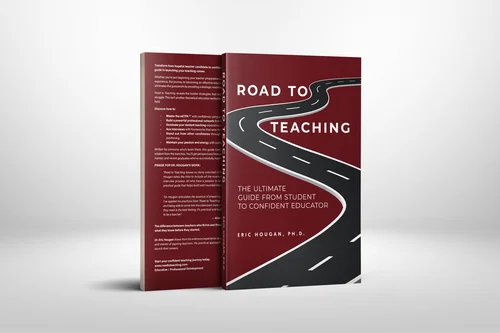
Want the whole road in your bag?
All 51 chapters plus 100+ interview questions, from your first education course to your first contract. Paperback $12.99, Kindle $7.99 on Amazon.