Land your ideal teaching job.
The teaching job search isn't a lottery, it's a process. The candidates who get hired apply strategically, build the right relationships, and walk into the interview ready. Here is how to do the same.
Getting hired is a process you can run on purpose
Landing a teaching job comes down to four things you control: how you stand out on paper, who advocates for you, how well you run the application process, and how you perform in the interview. Most candidates only work on the last one, and only after they have already applied.
Strong candidates work all four, and they start early. They build a resume that earns the interview, get their materials in front of the people who actually hire, activate the relationships they built during their program, and walk in with answers they have already rehearsed. None of it is luck. It is a system you can follow.
This page pulls together the free resources for this stage and shows where Road to Teaching takes you deeper.
The teacher shortage is giving way to a tighter market
For years the headline was a teacher shortage. That reality is changing. As one-time federal pandemic funds expire and declining enrollment squeezes district budgets, many districts are cutting positions and slowing hiring — so in a growing number of places, more candidates are competing for fewer openings. Shortages still persist in high-need subjects and regions, but you can no longer assume a job will simply be there.
The takeaway is simple: be prepared. In a tighter market, the candidates who get hired are the ones who stand out, build relationships, and interview with evidence. The four moves below matter more than ever.
Researchers describe today's market as a paradox of layoffs and shortages happening at once. Learning Policy Institute analysis →
Four things that separate offers from rejections
Work all four, not just the interview, and start before the postings go live.
Differentiate yourself
In a crowded pool, "qualified" isn't enough — a committee needs a concrete reason to pick you. Stack the signals that show range and readiness: an added endorsement (special education, ESL, or a shortage subject), experience across grade levels and student populations, and evidence of impact, like improved student outcomes or a program you helped build. Then make those differentiators impossible to miss on your resume and in your answers.
Leverage your network
Many teaching jobs are filled through a recommendation long before, or instead of, a competitive posting. Your professors, cooperating teachers, principals, and fellow candidates hear about openings first, and their word carries real weight with hiring committees. Nurture those relationships while you're still in your program, ask for reference letters and recommendations early, and make sure people know exactly what and where you want to teach.
Run the application like a pro
Submitting through the district portal is the floor, not the strategy. Tailor your resume and cover letter to each posting, then get your materials directly in front of the people who decide — the principal, the department chair, even the office manager — so you never disappear into an applicant-tracking system. A short, professional email that shows you researched the school signals genuine interest and keeps your name top of mind.
Win the interview
The interview is where offers are won or lost, and the strongest candidates rehearse. Use a repeatable framework so you can answer any question with structure, specific strategies, and evidence of student learning, then close with an authentic story. Prepare for the behavioral and scenario questions committees lean on, bring thoughtful questions of your own, and follow up afterward to leave a strong final impression.
Walk in ready, for free
Two free ways to prepare before your first application goes out.
The Teacher Interview Prep Kit
The questions hiring committees ask most, plus a worksheet to build and rehearse your answers. A free taste of the interview chapter from the book, sent straight to your inbox.
Browse 100+ interview questions
Real teacher interview questions by category — classroom management, philosophy, assessment, and more — each with guidance on how to answer.
Browse the questionsWhat Road to Teaching covers for the job search
The complete system for turning your training into a signed contract.
- Build a teaching resume and cover letter that earn the interview
- Run the full application process, online and in person
- Network your way to openings before they are posted
- Answer 100+ real interview questions with a proven 5-step framework
- Handle tough behavioral and scenario questions with confidence
- Differentiate yourself with endorsements and added experience
- Make a strong final impression and follow up the right way
- Evaluate and accept the offer that is right for you
The 5-step interview answer framework
Deliver compelling, structured responses that show both your expertise and your passion.
Understand
Listen for what the question is really asking before you answer.
Values
State the belief or philosophy behind your response.
Approaches
Describe the specific strategies you would use.
Benefits
Connect those strategies to student learning.
Examples
Ground it with a real story from your experience.
The book uses this framework to answer all 100+ interview questions.
Your job-search resource library
Expert job-search insights
Apply through the online system, but also email your resume individually to the recruiter, administrator, and department chair. It prevents your resume from getting lost and shows deep interest.
The resume explains your experience and the classes you taught. It is what makes the final sale to secure your place on the interview list.
Hiring committees can see passion in your eyes and hear it in your words. It is the fire that makes teaching the best job in the world.
Teaching job search FAQ
How do you get a teaching job?
Treat it as a four-part process: differentiate yourself on paper, build relationships that lead to recommendations, run the application well (apply online and get your resume directly to the hiring decision-makers), and prepare structured interview answers in advance. Working all four early is what separates candidates who get offers from those who only apply and hope.
How long does the teacher hiring process take?
It varies widely. Many districts post and hire in the spring and summer for the next school year, while others fill openings year-round as vacancies appear. From application to offer often takes a few weeks to a couple of months, so the earlier you prepare your materials and start networking, the better positioned you are when a posting goes live.
Is there still a teacher shortage?
In some areas, yes. Special education, STEM, bilingual education, and many rural and high-need districts continue to face shortages. But the broader picture is shifting: as pandemic-era federal funding expires and enrollment declines pressure budgets, many districts have cut positions and slowed hiring, so a growing number of roles are now competitive. Whether you face a shortage or a crowded field depends heavily on your subject, your region, and how far you are willing to go for the role.
What should a teaching resume include?
Your credentials and certifications, the grade levels and subjects you have taught, student teaching and field experience, measurable contributions to student learning or school improvement, and any co-curricular activities you led. A focused, evidence-rich resume is what earns you a spot on the interview list.
How do I stand out as a teaching candidate?
Differentiate yourself with added endorsements, diverse classroom experience, and specialized skills that match district needs, then get your materials in front of the actual hiring decision-makers rather than relying on the online portal alone. A genuine recommendation from a professor or cooperating teacher carries real weight.
How do I prepare for a teacher interview?
Practice with real questions and a repeatable structure. Use the 100+ interview questions on this site and the 5-step framework above to build answers that pair specific strategies with evidence of student learning and an authentic story.
What does Road to Teaching cover for the job search?
Part III walks you through the resume and cover letter, the full application process, networking, 100+ interview questions with the 5-step framework, and how to evaluate and accept an offer. See the book.
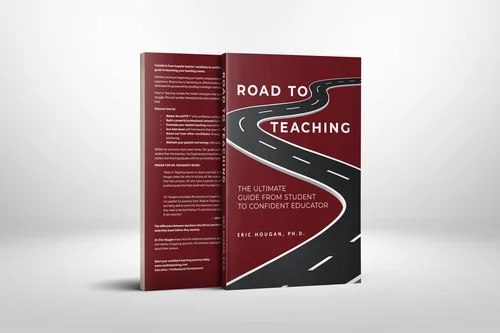
Get the complete job-search system
Resume, applications, networking, and 100+ interview questions with the 5-step framework — everything you need to turn your training into a signed contract.