Chapter 28 is a set of simple classroom management habits you can use in someone else’s classroom: bell work, a question box, a plan for paperwork, no empty minutes, consistency, and watching the room. It is for student teachers who are nervous about managing a class, which is most of us at the start. If you are preparing for interviews, this post on classroom management interview questions shows how to talk about these habits, and Chapter 27 comes right before this one.
This is Chapter 28 of 51 from Road to Teaching (2025 edition). Read the whole book free, in order, at Read the Book.
By Dr. Eric Hougan
“It’s hard to be fully creative without structure and constraint. Try to paint without a canvas. Creativity and freedom are two sides of the same coin. I like the best of both worlds. Want freedom? Get organized. Want to get organized? Get creative.”David Allen
Most student teachers enter their practicum concerned about classroom management. The anxiety they may feel stems from inexperience and a lack of understanding of how to effectively apply classroom management techniques to their teaching. Classroom management, as a whole, is a broad subject and a thorough examination of all it encompasses is outside the scope of this book. However, it is still important to understand the purpose and importance of its role in teaching.
To begin, classroom management can be defined as a system of practices that increases learning, lowers behavioral problems but most importantly, communicates your expectations to your students. Successfully managing a classroom hinges on a combination of factors including building positive relationships with students; maintaining set procedures and routines with consistency; and monitoring for engagement and compliance.
Keep in mind that as a student teacher, you will need to adhere to and respect the cooperating teacher’s classroom management style. However, if you identify some classroom issues that interfere with the students’ learning, then you can try various classroom management strategies to address the problem. In this section, you will find several quick and easy classroom management techniques that can be implemented at any grade-level.
Today’s classroom management incorporates understanding of trauma-informed practices, social-emotional learning, and culturally responsive teaching. Effective classroom management today goes beyond simply controlling behavior—it focuses on creating environments where all students feel safe, valued, and capable of learning.
Use Bell Work
One classroom management technique, applicable to K-12 grades, includes an exercise called “bell work,” also known as entry tasks or morning work. Bell work is straightforward and can easily be modified based on what your class is currently learning. How it works is that, on a regular basis, students begin the class period or day by working on some sort of writing prompt, math problem, or other relevant tasks. Typically, this bell work is posted on the whiteboard or projected onto a screen using a computer or document camera.
For example, upon entering the class, you may have students respond to the following prompt: “We are learning about persuasion. Illustrate or write about a situation you had to convince someone to do something.”
This simple technique has many benefits: bell work provides a consistent routine, so the students know what is expected of them from the minute they walk into the classroom; it reduces student misbehavior; and, it shortens the time it takes to begin the class period or day. Bell work wakes up the brain and gets students in the mindset to learn. It can help spur students’ interest in the day’s lesson or encourage them to review information from previous lessons. Ideally, these tasks will also build on the students’ background by connecting to their lives and their existing body of knowledge.
Giving students a set task at the beginning of the day gives you, the teacher, time to take care of administrative tasks such as taking attendance, lunch count, or even a moment to talk with a student one-on-one. Bell work also eliminates class downtime, which increases learning time for the students. Assume that a teacher working in a 180-day school uses bell work and reduces downtime by four minutes a day. This translates to an additional 12 hours of learning time for the students in a year. Using meaningful bell work in a consistent manner will lead to improved student learning and will reflect positively in your student teaching evaluations.
Digital tools may enhance bell work effectiveness:
- Online platforms: Use tools like Google Classroom, Padlet, or Flipgrid for interactive bell work
- Digital displays: Rotate between different types of media—videos, images, interactive polls
- Student choice: Provide multiple bell work options to accommodate different learning preferences
- Real-time feedback: Use polling tools to immediately gauge student understanding
Be aware that bell work can quickly become stale or boring. To help keep the bell work fresh (and effective), invite students to assist you in developing future bell work tasks. Involving students in the creation process is just another way to give them more ownership over their learning, which can result in higher student engagement. Be sure to also provide student choice (e.g., ways of responding), as well as opportunities for social interaction. In short, strive to make bell work fun, authentic, and meaningful.
Try a Question and Concern Box
A question and concern box can also be an effective tool for classroom management. It gives students a way to express questions that may seem pressing to them, but in a way that does not disrupt the flow of the lesson and class. The following example describes a student teacher’s experience in implementing the question and concern box strategy.
The student teacher was feeling frustrated when students would interrupt a class discussion or instructions with questions not relevant to the topic of discussion. The students’ questions ranged from, “What is my grade in the class?” to “What homework do I need to make-up?” While valid questions, they are not appropriate during classroom instruction or discussion time. Ultimately, the students’ untimely questions reduced instruction time, detracted from meaningful class discussions, and negatively impacted the students’ learning.
To remedy this situation, the student teacher explained to the students that their questions and concerns were valid, but these types of questions would be handled with a question and concern box. Students were instructed to kindly write notes with their questions or concerns, place them in the box, and have a response from the student teacher within twenty-four hours (for middle school students writing a note was going to be no problem).
At the primary level, students who struggle with reading or writing may be unable to write sentences to express their concerns or questions to you. However, with a few simple modifications, younger students can benefit from this technique as well. One idea is to give students access to different colored sticky notes and explicitly teach students what each color means. For example, if students have a question they can use a yellow sticky note, for a concern or problem they need help with they use a blue sticky note, etc. The student can write their name and date on the note and stick it in a box or some other accessible place (like a laminated poster or “jot lot” near your desk).
Another idea is to create a customized slip that students can fill out without having to write sentences. The slip would contain visuals that students can just circle or check off to express what they need. Again, you must explicitly teach students how and when to use the slips in order for the technique to work effectively. In addition, you must follow-up with students in a timely and consistent manner, otherwise, this strategy will quickly lose its efficacy.
Digital alternatives to the traditional question box include:
- Online forms: Create Google Forms or similar tools for anonymous question submission
- Classroom apps: Use platforms like Seesaw or ClassDojo for student communication
- Virtual sticky notes: Utilize tools like Padlet for digital question posting
Overall, in using this strategy, you may find fewer students derailing group discussions with irrelevant questions, and class instruction stayed on point. Plus, students appreciated the personalized (and non-rushed) response which helped strengthen the teacher-student relationship.
Managing the Paperwork
Student teachers often struggle to return graded papers. The amount of paperwork to be checked and properly graded can be overwhelming, even without trying to provide high-quality feedback on the students’ work. Most student teachers do not have a plan for returning students’ work in a timely fashion. Even work that is graded with feedback sits on the teacher’s desk for too long. Feedback is more effective when delivered in a timely fashion, so creating a plan for grading and returning your students’ work is crucial.
One approach to consider is inviting the few high-energy students (that may also be prone to misbehavior) to assist. Of course, you could have this role and responsibility rotate among all your students if you so choose. Let the students know you will put the graded feedback in a certain place or folder, ask the students to check this space or folder on a daily basis, and, if there’s graded work, have the students automatically pass out the work at a specific time of the day.
To implement this approach, talk to students privately and express your need for their assistance. Typically, the students will be intrigued by the thought that a teacher needs help and will jump at this opportunity. If the students agree to help, the obvious benefit is that the students burn off some energy but more importantly, the student helpers will begin to view themselves as a valuable part of the classroom, which can help promote a more positive student identity. The increased involvement may also encourage the student helpers to participate more in other class activities. Finally, using this approach, the students’ work with feedback will be returned in a timely and consistent manner.
Modern approaches to paperwork management include:
- Digital submission: Use learning management systems to reduce physical paper handling
- Audio feedback: Provide voice comments on digital submissions for more personal responses
- Peer feedback: Train students to give each other constructive feedback on certain assignments
- Self-assessment: Teach students to evaluate their own work against rubrics and criteria
- Streamlined grading: Focus detailed feedback on fewer, high-impact assignments
Maximize Class Time
Nothing will spin your classroom into chaos faster than completing a lesson plan 5-10 minutes before the dismissal bell rings—thus creating downtime for the students. Devoting insufficient time for lesson planning is one of the biggest mistakes teachers make, and this lack of planning may quickly lead to student misbehavior. While you are distracted, mischievous children begin to move towards the door, others may begin to play fight, and others will put their heads down. In any case, this downtime will result in a disengaged and chaotic classroom.
The good news is, with a little extra preparation and planning, you can transform class downtime into rich instructional and evaluative time. This can be accomplished by over-planning your lessons and having back-up activities readily available. Consider planning for 10-15 minutes more instruction than you think you will need. Outlined below are several different ways to utilize this extra time:
- Plan a backup activity that can be easily modified based on your current lesson objectives. This can be a quick game, a think-pair-share, or some other activity that involves active responding from students.
- Use exit slips to have students reflect on and evaluate their learning. Review the lesson objectives and ask students to complete a brief self-evaluation on whether they feel they have met the stated objectives, making sure to explain why or why not; or have them highlight an area of some learning or growth they achieved by noting some big takeaways. Alternatively, you can have students summarize their learning or pose clarifying questions that can be addressed the following day. As students leave the classroom, they hand you their feedback, allowing you to quickly assess their learning and make modifications for the following day’s instruction.
- Outcome sentences are another useful strategy for evaluating learning and eliminating downtime at the end of a lesson. For this strategy, the teacher prepares various outcome sentences that can be posted on the wall or projected onto the board. The teacher then asks the students to write down and state an outcome sentence. This can be done individually, in partners/small groups or as a whole class. Some examples would be: “I learned...”, “I was surprised...”, “I wonder...”, “I think...”. This quick and engaging activity allows students to think about their learning and share it with others. From the teacher’s perspective, outcome sentences serve as an insightful evaluation tool to check students’ understanding of the lesson.
Additional strategies for maximizing class time:
- Brain breaks: Use 2–3-minute movement or mindfulness activities to re-energize students
- Review games: Quick, competitive activities that reinforce learning objectives
- Preview activities: Brief introductions to tomorrow’s lesson to build anticipation
- Reflection journals: Short writing activities that help students process their learning
- Peer teaching: Have students explain concepts to each other in the final minutes of class
Be Consistent
Consistency is a common and critical thread woven into the fabric of effective classroom management. How you run your classroom communicates your expectations, and consistency is the driving force for accomplishing this. Students will be unable to identify their boundaries if you allow certain behaviors one day and then give consequences for the same behavior on a different day. Not only is it confusing for students, but they will quickly learn that when you ask them to do something, you don’t really mean what you say. Consistency also communicates to students that the tasks you give them have purpose and meaning.
It is important to note that implementing and enforcing any kind of expectation can be messy and consistency is the key to managing this. There may be chaos at first, but you still must give students a fair amount of time to process, learn and practice these new expectations/approaches (i.e., new routine, procedure, process, or technique). You may feel a sense of frustration or helplessness if things are not going as you had planned (or hoped) but continue using your chosen approach and monitoring the progress. If the results are unsatisfactory over time, then try adjusting your approach rather than abandoning it. Quickly abandoning the approach will again only communicate to students that you do not mean what you say and you will see behaviors and non-compliance begin to rise.
Current understanding of consistency includes flexibility for individual student needs:
- Consistent expectations with flexible methods: Maintain the same standards while allowing different pathways to meet them
- Trauma-informed consistency: Understand that some students may need additional support to meet consistent expectations
- Cultural responsiveness: Ensure your consistency doesn’t conflict with students’ cultural backgrounds or family values
- Growth mindset: Focus on consistent effort and improvement rather than consistent perfection
Develop Withitness
Build your capacity in becoming aware of what’s happening in the classroom at all times, which is often referred to as having withitness. Student teachers may make the mistake of not taking the time to monitor for student compliance. It is all too tempting to give students a task and then immediately start bustling around the room. By doing this you are inadvertently sending the message to students that getting to work right away is optional because you are not stopping long enough to make sure they do so.
To avoid falling prey to this temptation, employ a strategy called “Stand and Scan”. This simple technique can be used at any time, at any grade level and is simple to implement. When giving directions, a task, or assignment, send students off and then stand silently at the front of the classroom and watch. Do not allow students to come up to talk to you or ask questions, do not address the whole class, and do not move from your spot. Your job is to watch and wait for all students to follow your directions which in turn communicates your expectations without having to say anything further.
Another integral part of this technique is to refrain from jumping on off-task behavior right away. Instead, watch the off-task student(s) for a minute or so, then approach them privately to remind them of your expectations.
For example, imagine you hand out a math problem set, send students off to work but one student is walking around talking to other students. She finally sits down but then begins playing with objects in her desk. Calmly walk up to the student, physically point to the paper and say “the expectation is that you are working on your problem set” then walk away, return to the front of the room and watch. Do not hover or nag, give the student a moment to process and start working. In addition, by returning to the front of the room you are again communicating that the only option is compliance.
Be careful in implementing this technique, as it will require you to be aware of your implicit bias. All teachers carry with them implicit biases that influence teacher behaviors and actions, which, in turn, may adversely affect students, specifically students of color. It is imperative that you do this meaningful work around unpacking your implicit bias to ensure a healthy and equitable learning environment. A useful resource to learn more about checking your bias in the classroom is Teaching Tolerance (https://www.tolerance.org/).
Next, regularly reflect on how you are monitoring. For instance, ask yourself: “How are you ensuring that you are monitoring your students equitably? Or are you monitoring certain students (e.g., students of color in the class) more intensely and frequently than other students (e.g., white girls in the class)? Are you responding to all students that are in non-compliance in an equitable and dignified manner?”
It is important to note that while this strategy is simple in nature; it can sometimes be tricky to implement consistently. As a novice teacher, it may feel very uncomfortable to let the class feel chaotic while students settle. One way to combat this feeling is to time how long you are actually standing at the front of the room. It will feel like an eternity, but in reality, it is only a few minutes at the very most. Additionally, as with every other strategy outlined above, the more consistent you are about following through with this technique, the more clear your expectations will be to your students.
Master the Day-to-Day Tasks
As a closing thought, when preparing for student teaching, take time to think through how you will handle all the various day-to-day classroom tasks. For instance, when and how will you hand back papers? How will you take attendance? How will you manage make-up work? Be sure to utilize social media and other teacher-based resources such as Twitter, Pinterest, Teacher Channel website, etc. to give yourself some jumping-off points.
Ultimately, your classroom management techniques should be tailored to you and your students. You will be unsuccessful if you choose strategies that you are unable to follow through with or implement correctly. Effective classroom management also requires continuous problem solving and experimentation, all while maintaining consistency and fairness. It requires you to be flexible and comfortable with trial and error. Lastly, keep in mind the importance and power of positive student-teacher relationships. Students’ role in managing your classroom is critical; successful classroom management always starts with and will be amplified by, the strong relationships you have built with your students.
Nowadays classroom management emphasizes proactive rather than reactive approaches:
- Preventive strategies: Design lessons and environments that minimize behavioral issues before they arise
- Positive behavior supports: Focus on teaching and reinforcing desired behaviors rather than just addressing problems
- Student agency: Give students voice and choice in classroom rules and procedures
- Restorative practices: When issues arise, focus on repairing relationships and learning from mistakes
- Data-informed decisions: Track patterns in student behavior to adjust your approaches effectively
Remember that classroom management is not about control—it’s about creating conditions where learning can flourish. The most effective classroom managers are those who build strong relationships with students, establish clear and fair expectations, and consistently follow through while remaining flexible enough to meet individual student needs.
Implement consistent routines and procedures that maximize learning time while maintaining your authentic teaching style. Effective classroom management isn’t about control—it’s about creating conditions where all students can learn and thrive while developing your confidence as a teacher.
Interviewing soon? See how this chapter turns into an answer: Classroom Management Interview Questions.
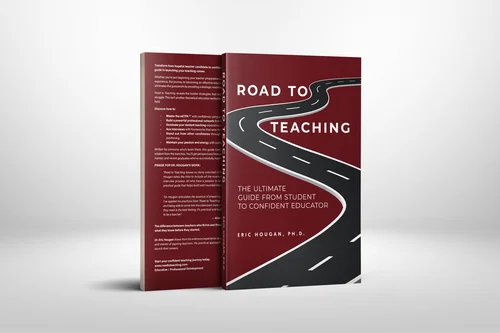
Want the whole road in your bag?
All 51 chapters plus 100+ interview questions, from your first education course to your first contract. Paperback $12.99, Kindle $7.99 on Amazon.