Background Teacher Interview Questions & Answers
The personal and professional questions hiring committees ask to understand who you are and why you chose teaching — each with a proven framework so your story shows real fit for the classroom.
How to answer any background question
Understand the intent
Hear the real question. “Why did you become a teacher?” is really about your genuine motivation and whether you'll stay committed.
State your value
Open with a belief: every child deserves an educator who sees their potential and helps them reach it.
Describe your approach
Get concrete: a specific moment, a mentor, or a tutoring experience that confirmed teaching was your calling.
Explain the benefit
Tie it back to students: that motivation shows up as patience, high expectations, and care for every learner.
Give a real example (optional)
A short, true story lands it — the student who finally “got it” and made you certain about your path.
Sample question: “Why did you become a teacher?”
“I believe every child deserves an educator who sees their potential, and a moment in a tutoring program made that real for me — a struggling reader finally clicked, and I knew this was my work. That motivation shows up every day as patience and high expectations for students who need both.”
TEACHING
PREP KIT
The Teacher Interview Prep Kit
- The 10 most-asked interview questions
- A proven framework for answering each
- Space to draft your own answers
15 most common background questions
Each answer applies the framework: state a value, describe a concrete approach, connect it to student learning.
Why did you become a teacher?
Lead with belief — every child deserves an educator who sees their potential. Anchor it to a real moment that confirmed your calling, then connect it to students: that motivation shows up as patience and high expectations every day.
Tell me about yourself.
Give a tight, relevant arc: what drew you to teaching, your training and student-teaching highlights, and the kind of classroom you build. Keep it professional and end on what you'll bring to their students.
Full response strategy →What is your educational philosophy?
State a clear belief about how students learn best, then make it concrete with the practices it drives in your room. Close with the benefit — students who are engaged, supported, and held to high expectations.
Full response strategy →What are your strengths? What are your weaknesses?
Name a genuine strength tied to student impact, with an example. For the weakness, pick a real growth area and show the concrete steps you're taking — self-awareness reads as professionalism.
Are you a risk taker? Give an example.
Frame calculated risk as instructional courage: trying a new strategy, redesigning a lesson, advocating for a student. Show your reasoning and what students gained, not recklessness.
Why should you be hired for this position?
Match your strengths to what this school needs. Lead with the value you add to students, back it with a specific example, and signal fit with their community rather than reciting your resume.
Describe your student teaching experience.
Tell a focused story: a challenge you faced, what you tried, and what students learned. Show growth and reflection — committees want a teacher who learns from the classroom, not a flawless highlight reel.
What do you like most and dislike most about teaching?
Be genuine about what energizes you — the moment learning clicks. For the dislike, name something real but frame it constructively, showing you handle the hard parts with maturity.
How do your life experiences prepare you for teaching?
Connect your background to classroom strengths — resilience, empathy, perspective. Always tie it to student impact: how your experiences help you reach and relate to the learners in front of you.
What motivates you to achieve your goals?
Link your drive to purpose — seeing students grow and succeed. Show how that motivation translates into persistence, preparation, and following through for the kids who need you most.
Are you a positive and energetic person? Give an example.
Don't just claim it — show it with a specific moment when your energy lifted a class or a struggling student. Positivity is contagious, and committees are picturing you with their students.
How would you describe yourself as a team member?
Schools run on collaboration. Show you contribute and listen: planning with colleagues, sharing resources, supporting the grade-level team. Tie it to the benefit — aligned teachers serve students better.
What was the most frustrating thing that happened to you as a student teacher?
Pick a real challenge, stay professional, and focus on what you learned and changed. The point isn't the frustration — it's your composure, reflection, and growth under pressure.
Where do you see yourself in 5 years?
Signal commitment and growth: a confident classroom teacher who keeps developing, takes on leadership, and stays invested in this community. Ambition that benefits students, not a quick exit.
What three words would your students use to describe you?
Choose words that reflect both warmth and rigor — like “fair,” “encouraging,” and “challenging” — and back each with a quick reason. It shows self-awareness and the classroom culture you build.
“Dr. Hougan's passion and book directly contributed to my success landing contract after contract.”— Tessa Acay, Third-Year Teacher
Pro tips for background questions
Be authentic
Hiring committees can spot rehearsed answers. Share genuine experiences and motivations that led you to teaching.
Connect to student impact
Always tie your background to how it helps you serve students better — show the line from your experiences to student success.
Use specific examples
Don't just say you're “passionate about teaching.” Share the specific moment that confirmed your calling to education.
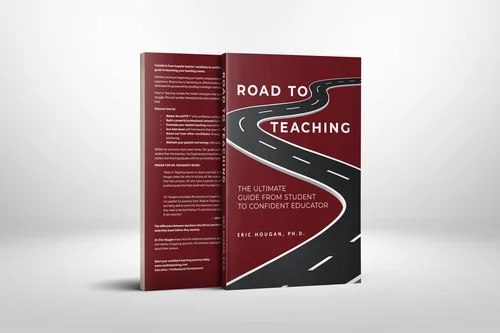
Get interview-ready for every question
Background questions are one category. Road to Teaching covers the rest with the same framework and worked examples, plus behind-the-table perspectives from a principal and a career counselor — and the whole journey from student teaching through signing your first contract.